
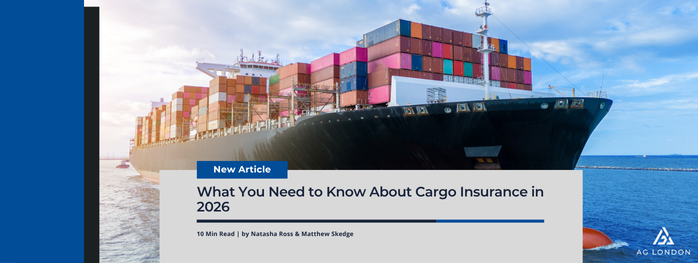
What You Need to Know About Cargo Insurance in 2026
By Natasha Ross & Matthew Skedge, AG London
10 Minute Read
Ask most people what cargo insurance covers and they’ll picture a container ship on the open ocean. That image isn’t wrong; it’s just wildly incomplete. Cargo insurance travels with goods from the moment they leave a factory floor to the moment they land on a retail shelf; touching trucks, planes, ports, warehouses, and everywhere in between. And right now, the cargo market is going through one of the more interesting chapters in recent memory.
Natasha Ross, Senior Vice President of AG London, and Matthew Skedge, Senior Vice President of the Cargo & Stock Throughput Division at AG London, are both cargo specialists at AG London. They walk us through the fundamentals of the coverage, what’s happening in the London market today, and why a pallet of AirPods keeps underwriters up at night.
Cargo Isn’t Just About Ships
The term “marine cargo” has a historical explanation that doesn’t quite fit modern reality. Cargo insurance has lived within the marine market for centuries because goods were historically moved almost exclusively by sea. Today, marine is actually an umbrella for several distinct lines: Hull Insurance covers the physical vessel, Protection and Indemnity (P&I) covers third-party liabilities and pollution risk, and cargo covers the goods themselves.
“In reality, cargo is probably closer affiliated to property insurance than it is to other marine lines,” Natasha explains. “The people buying cargo coverage are often the same people who own the warehouse where those goods are stored. We have much more crossover with the property market than we do with the vessel owners.”
Coverage follows the goods through their entire journey: what Natasha calls “cradle to grave.” That means a manufacturing facility in one country, distribution by truck to a port or airport, ocean or air transit, arrival at a warehouse or distribution center in another country, and potentially the final exposure at a retail location. Stock throughput policies can cover the full chain in a single placement.
AG London also writes more unique lines like freight liability and warehouse legal liability alongside traditional physical loss or damage on cargo. These coverage types have seen growing demand as the capacity market has widened its appetite.
What’s Moving Through the Market Right Now
The short answer: everything. Hair brushes, food and beverage, agricultural commodities, industrial equipment, components for large construction projects. But a few trends are reshaping conversations between brokers and underwriters in ways that weren’t true even five years ago.
Data centers are at the top of that list. “We are seeing a lot of data centers and servers and tech. They are risks that underwriters are still learning about,” says Natasha. “What happens to them in a fire? What about overheating? They are treading that ground carefully, and more underwriters are entering the space, but with caution, because it’s new.”
A second trend is subtler but arguably just as significant: technology is getting smaller and more valuable at the same time. A truck full of traditional cargo has a relatively predictable loss profile. A truck loaded with pallets of AirPods, Oura rings, or similar high-value compact tech? One stolen pallet can easily generate a six-figure loss. The concentration of value in a very small physical footprint is creating exposures that didn’t exist a decade ago and that underwriters are still calibrating.
Before tech became the talking point, electric vehicle batteries occupied that same space. It was a relatively new category of cargo with significant uncertainty around the key perils (fire risk, in particular) that underwriters had to work through before getting comfortable. Each new technology wave brings a version of the same challenge: identifying the unique risks of each.
The London Market Today: Soft, Competitive, and Expanding
The cargo market in London is currently in a soft cycle, meaning buyers are in a favorable position. Rates have been declining, and new capacity has poured into the market. That competition is producing two visible effects: underwriters are widening their coverage terms, and they’re expanding the types of risks and cargo categories they’re willing to write.
“As the cargo market is generally doing quite well, they are under increased pressure to bring in more revenue,” Natasha notes. “When they hear that there are suddenly loads of data centers being built and needing coverage, they are thinking: ‘we need to find a solution for this and be among the first to offer it.’”
AG London has access to over 40 cargo and stock throughput markets in London. Our role and our value lies in knowing which of those markets has genuine appetite for a given risk. The underwriter who is comfortable with data center exposure may not be the same underwriter who is the right home for a fresh produce account. That market knowledge is what turns a submission into a placement.
How Lloyd’s Works (and Why It Matters)
Lloyd’s of London isn’t an insurance company; it’s a marketplace made up of syndicates. Those syndicates are backed by insurance companies you’d recognize: carriers like The Hartford, Axis, and Beazley all operate Lloyd’s syndicates. The underwriters writing business in that marketplace are doing so on behalf of their companies, but within the Lloyd’s structure.
What sets Lloyd’s apart is the security structure behind it. Each year, syndicates contribute to a central fund. This fund is a backstop that ensures claims are paid even if a syndicate faces financial difficulty. The result is that insureds placing business in the London market have a layer of protection that goes beyond the individual carrier. Syndicates are also subject to dual scrutiny: their own company’s internal oversight and Lloyd’s review of their underwriting practices.
It’s a system that’s been stress-tested for over three centuries, which is perhaps the most straightforward argument for its credibility.
What Makes a Great Broker-Partner Relationship
When asked what they look for in the agencies and brokers they work with, Natasha and Matthew’s answer is direct: honesty, communication, and a shared sense of purpose around getting the right outcome for the client.
“We try to be upfront with our clients. If it’s not something we can do, or we don’t think we’re going to be able to offer the best terms, we’ll say your best place is the domestic market on this. We expect that to go both ways,” explains Matthew.
The Bottom Line
Cargo insurance is one of those lines that looks straightforward until you’re actually in it. The goods being moved around the world are more varied, more valuable, and more complex than ever. The risks emerging from new technology categories are still being defined in real time. And the London market with its unique structure, deep capacity, and centuries of precedent remains one of the best places in the world to find creative solutions for hard-to-place risks.
Our Products Offered:
- Stock Throughput
- Transit-only (Domestic and/or International)
- Stock-only (Storage)
- Top-up / Excess Towers
- Project Cargo / Delay In Start-Up (DSU)
- Shipper’s Interest
- Warehouse Legal Liability
- Freight Liability
- Trade Disruption Insurance
- Cash In Transit / General Specie / Fine Art / Jeweler’s Block
- Contractors Equipment / Oil Field Equipment Floaters
- Complimentary Terror / Political Violence Products via In-House Vehicle
- Product Recall
Our Key Industries Served:
- Food and Beverage Manufacturers and Distributors (including Chilled/Frozen)
- Apparel
- Pharmaceuticals / Life Sciences
- Manufacturers
- Wholesalers
- Technology
- Wineries, Distilleries, and Breweries
- Logistics Providers
- Importers/Distributors
- Forestry Products
- Equipment and Machinery
- Vehicle Manufacturers and Franchises
For a full overview of AG London’s cargo product capabilities, please click here.
If you have a risk you’d like to talk through, reach out directly. That’s what we’re here for.
